

Installing a garage door requires precise measurements, proper tools, and at least one or two helpers, as doors can weigh up to 400 pounds. A typical DIY installation takes 8 to 10 hours. Overhead Door Company of Santa Rosa, Inc.™ proudly provides professional garage door services throughout Napa County, Lake County, Mendocino County, Marin County, and Sonoma County.
Key Takeaways
-
Garage doors weigh up to 400 pounds, requiring one or two helpers for the entire 8-to-10-hour installation process.
-
Measurements must be taken from the opening itself, not the existing door, to prevent ordering the wrong size.
-
The required rear clearance equals the door height plus 24 inches, with a minimum of 6 inches of side clearance.
-
A garage door assembly contains lethal energy in the torsion springs, which only certified technicians should handle.
What Do You Need Before Starting?
Installing a garage door requires precise measurements, the right tools, and at least one helper. A standard How to Install a Garage Door project takes 8 to 10 hours for a typical DIY effort, according to Clopay. Without proper preparation, homeowners risk ordering the wrong size door or creating a dangerous installation scenario.
What measurements are required before ordering a door?
Measurements must be taken from the opening itself, not the existing door. Garaga emphasizes that homeowners should never measure in relation to the old door. The required rear clearance equals the door height plus 24 inches. A minimum of 6 inches is needed between the door jamb and the wall.
What are the standard garage door sizes?
Standard single doors measure 7 feet high by 8 or 9 feet wide. Standard double doors are sized for a two-car opening. These dimensions determine the opening size and the hardware required for the project.
Why are helpers necessary for this project?
Garage doors weigh up to 400 pounds. That weight makes the panels impossible to manage alone. Clopay recommends one or two helpers for the entire 8-to-10-hour process. Attempting the job solo increases the risk of injury and door damage.
For homeowners who find these requirements daunting, Overhead Door Company of Santa Rosa, Inc.™ proudly provides professional garage door services throughout Napa County, Lake County, Mendocino County, Marin County, and Sonoma County. The company’s technicians handle every detail from opening assessment to final balance testing.
How Do You Prepare the Opening?
Preparing the garage door opening correctly prevents costly installation errors and safety hazards. A precise opening ensures the new door operates smoothly and seals properly against weather and intruders.
What Measurements Are Needed Before Installation?
Accurate measurements determine the door size and required clearances. The opening width and height must be measured at multiple points to account for any unevenness in the framing. Standard single doors are typically 7 ft. high by 8 or 9 ft. wide. The opening must also provide adequate rear clearance, calculated as the door height plus 24 inches, and a minimum of 6 inches of side clearance between the door jamb and the wall.
How Should the Opening Be Inspected and Repaired?
A thorough inspection identifies structural issues that compromise the new door’s performance. The jambs must be plumb and the header level. Any rot, cracks, or shifting in the wood framing requires repair before proceeding. The floor should be level across the entire width of the opening. Uneven surfaces create gaps under the door seal, reducing energy efficiency and allowing pests and water to enter.
-
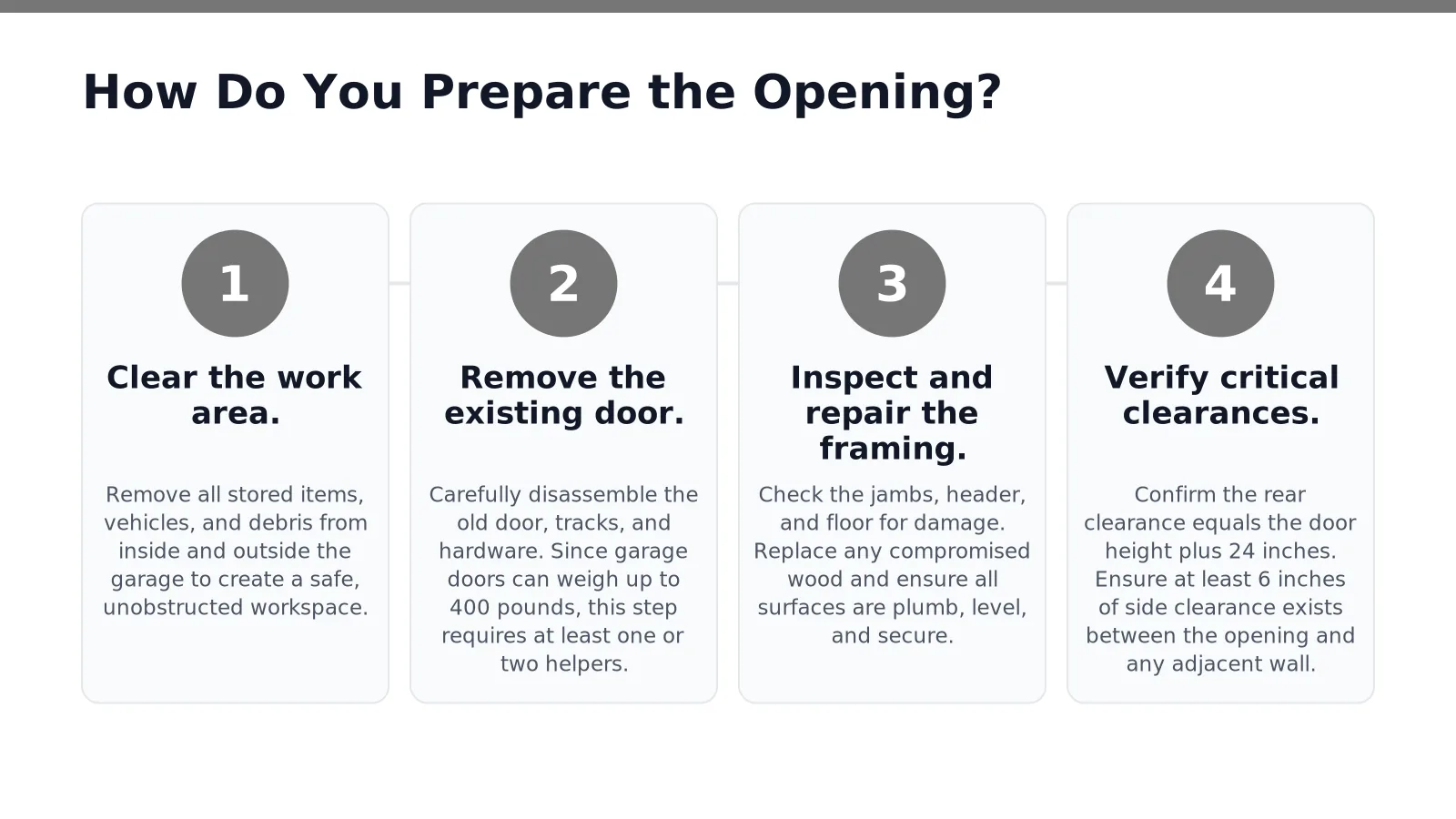
Clear the work area. Remove all stored items, vehicles, and debris from inside and outside the garage to create a safe, unobstructed workspace.
-
Remove the existing door. Carefully disassemble the old door, tracks, and hardware. Since garage doors can weigh up to 400 pounds, this step requires at least one or two helpers.
-
Inspect and repair the framing. Check the jambs, header, and floor for damage. Replace any compromised wood and ensure all surfaces are plumb, level, and secure.
-
Verify critical clearances. Confirm the rear clearance equals the door height plus 24 inches. Ensure at least 6 inches of side clearance exists between the opening and any adjacent wall.
Certified technicians perform accurate diagnostics and efficient repairs to help extend the life of every garage door system. For homeowners who choose professional installation, Overhead Door Company of Santa Rosa has delivered dependable residential solutions backed by experienced technicians since 1972. Professional residential garage door installation enhances curb appeal, improves functionality, and increases home value. Homeowners can choose from traditional, insulated, carriage house, contemporary, and custom wood garage doors with expert guidance and precise installation for dependable long-term performance.
What Are the Step-by-Step Installation Steps?
Installation demands rigorous preparation for safety and precision. Installing a garage door is far more complex than hanging a standard entry door. The process is inherently difficult and carries serious safety risks, as documented by HowStuffWorks. A homeowner without professional training faces dangers from heavy components and high-tension springs. The initial phase involves removing the old door and meticulously preparing the opening, ensuring the rough frame is structurally sound and perfectly plumb.
What safety precautions are mandatory before starting?
A garage door assembly contains lethal energy, primarily in the torsion springs. Certified technicians use specialized winding bars and safety protocols to release this tension safely. No novice should attempt spring removal or adjustment. Side clearance must be adequate for the track hardware, and rear clearance requires the door height plus a precise overhead allowance. Protecting eyes and hands with safety glasses and heavy-duty gloves is non-negotiable throughout the process.
A systematic installation sequence transforms a dangerous job into a manageable procedure for an expert. The installer first assembles the bottom section and attaches the weather seal. Vertical tracks are mounted and plumbed to the jambs. Following that, the remaining door sections are stacked and connected with hinged hardware. Torsion spring assembly is then completed and wound to the correct torque to balance the door’s considerable weight.
How is the opener system integrated after the door is hung?
Installing a manual door proves significantly easier than an automatic one, HowStuffWorks notes. A manual version is much lighter and eliminates the need for a motor or complex cable systems. However, automatic operation introduces critical safety logic not present in manual configurations. An automatic door immediately stops closing and reverses its direction if the beam detects an obstruction. This safety threshold is non-negotiable for protecting children and pets.
Modern garage door openers provide quiet operation, enhanced security, and convenient smart access features. Overhead Door Company of Santa Rosa equips these systems with rolling code encryption to prevent unauthorized entry. Professional programming locks the travel limits and force settings to factory specifications. Battery backup systems keep the door functional during a power outage, which is vital for homes in storm-prone regions. Testing the auto-reverse mechanism with a 2×4 block after installation confirms the safety circuit works correctly.
What Are the Key Safety Hazards?
Installing a garage door presents serious physical and security risks. Garage doors can weigh up to 400 pounds, demanding one or two helpers for safe handling. Without proper precautions, a homeowner faces crushing injuries, property damage, and security vulnerabilities.
Why Is the Weight of the Door So Dangerous?
A standard sectional door exerts tremendous force through its springs and panels. Clopay’s installation guidance confirms that a single door can reach 400 pounds. That mass becomes uncontrollable if a spring snaps or a panel slips during assembly. Torsion springs store enough energy to break bones on contact. A homeowner working alone risks being pinned beneath the falling door. The company’s technicians, drawing on more than 107 years of combined team experience and an estimated 194,400 completed projects and service calls, routinely manage these forces with specialized tools and training.
Can a Garage Door Opener Be Hacked?
Automatic garage doors have radio-operated motors. HowStuffWorks reports that anyone can hijack these motors with an inexpensive device that sniffs out the door motor’s frequency. An attacker captures the signal and replays it to open the door. This vulnerability turns a secure entry point into an unlocked access route. Modern openers use rolling-code technology to counter this threat. Older units lack that protection entirely.
What About High-Wind Failures?
Lightweight aluminum doors face a different hazard. Strong gusts can buckle an unrated door or tear it from its tracks. Wind load options are available for aluminum garage doors to add protection from high-wind speeds. The company offers wind load courtyard garage doors engineered to meet stringent building codes. A door that collapses during a storm exposes the home’s interior to debris and water damage. The structural failure also creates a massive security breach until repairs are complete.
When Should You Call a Professional?
Professional installation prevents costly mistakes and safety hazards. A garage door weighing up to 400 pounds demands specialized tools and trained handling.
How to Install a Garage Door safely requires precise measurements and spring tensioning. Garaga specialists recommend contacting an expert to avoid measurement errors that lead to ill-fitting doors. A door ordered to incorrect dimensions wastes time and money. The company provides free estimates and precise installation for dependable long-term performance.
What risks come with DIY garage door installation?
Improper spring adjustment creates dangerous recoil force. Incorrect track alignment causes premature wear on rollers and cables. These failures often go unnoticed until a door jams or collapses. Homeowners lose both the door investment and the labor hours spent.
How does professional installation protect the door warranty?
Manufacturer warranties frequently require certified installation to remain valid. Self-installation voids coverage on panels, springs, and hardware. Overhead Door Company of Santa Rosa serves Napa, Lake, Mendocino, Marin, and Sonoma counties with certified technicians. The company’s garage door services in Napa County extend to communities needing expert repairs and access systems.
Fiberglass garage doors offer a variety of architectural styles that capture the beauty of natural wood without the maintenance. These doors conceal durable steel construction beneath molded wood-grain surfaces. Professional installers ensure weather sealing and structural integrity that DIY methods often miss.
FAQ
Why do I need helpers for this project?
Garage doors weigh up to 400 pounds, making the panels impossible to manage alone. Clopay recommends one or two helpers for the entire process.
How long does a garage door installation take?
A typical DIY installation takes 8 to 10 hours, factoring in measuring the opening, removing the old door, and installing the new sections, tracks, and springs. Professional installation is often faster since certified technicians handle every step, from opening assessment to final balance testing, with specialized tools.
What size garage door do I need?
Standard single doors measure 7 feet high by 8 or 9 feet wide, while standard double doors are sized for a two-car opening. The exact size depends on measurements taken from the opening itself, including the required rear clearance of the door height plus 24 inches and a minimum of 6 inches of side clearance.
Is it safe to handle the torsion springs myself?
No. A garage door assembly contains lethal energy, primarily stored in the torsion springs, and only certified technicians should wind, adjust, or remove them. Attempting this without specialized winding bars and safety protocols risks serious injury.
Does Overhead Door Company of Santa Rosa offer free estimates?
Yes. The company provides free estimates along with precise installation for dependable long-term performance, and its certified technicians serve Napa, Lake, Mendocino, Marin, and Sonoma counties.
Conclusion
A garage door installation demands precise measurements, careful spring tensioning, and strict safety protocols that a homeowner cannot replicate without specialized tools and training. The risks of crushing injuries, voided warranties, and security vulnerabilities outweigh any perceived savings. Contact a certified installer to ensure the door operates safely, meets building codes, and delivers lasting performance.